Barrel, Muzzle Device, and Receiver Shapes
Barrel length is not random. It reflects what the gun is supposed to do, at what distances, and with what ammunition. A long barrel tells you the designer cared about velocity and accuracy. A short barrel tells you they cared about compactness.
The same is true of muzzle devices. Flash hiders, muzzle brakes, suppressor mounts, and plain crowned muzzles all send different signals. Add the receiver shape and you have a three-part visual signature that narrows down possibilities faster than almost any other combination.
Barrel length as a role indicator
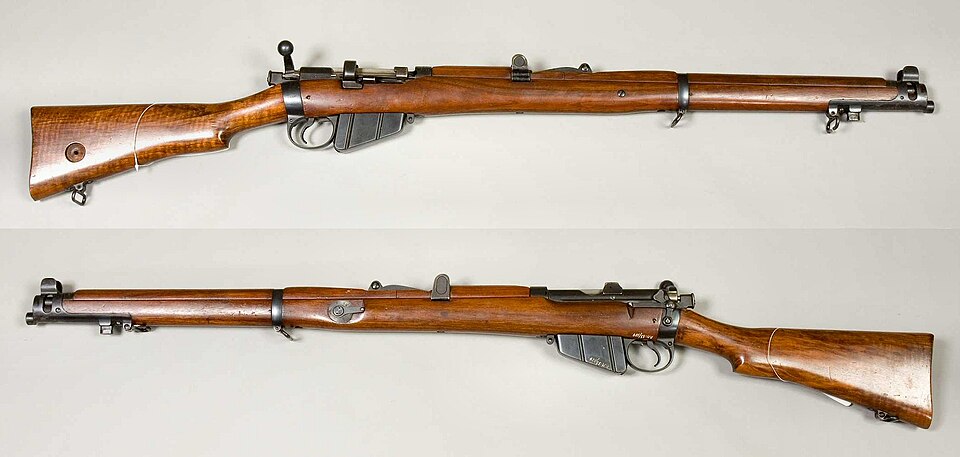
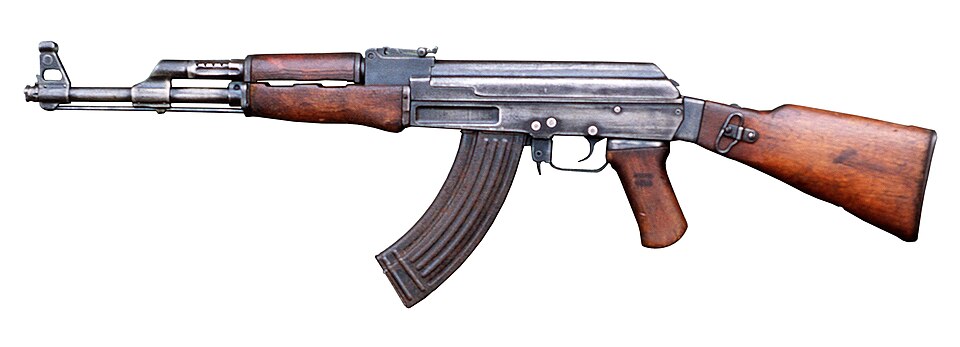
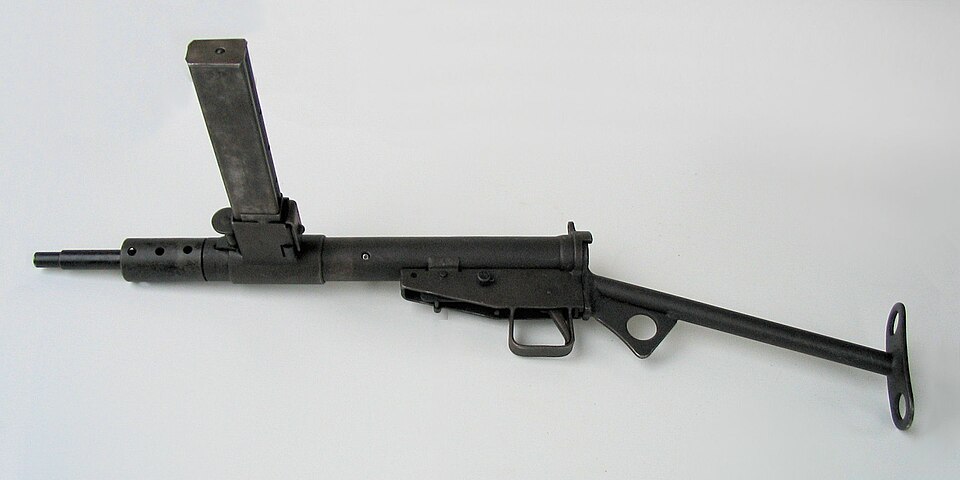
Military rifles before 1940 almost universally had long barrels. Twenty-four inches was common. Smokeless powder needed a long run to accelerate a heavy bullet, and iron sights of the era did not work well at short range. A long barrel also made the rifle easier to use with a bayonet.
The British Lee-Enfield had a barrel that looked impossibly long by modern standards. The German Mauser 98 was similar. The American Springfield 1903 had a twenty-four-inch barrel that made the rifle feel front-heavy. These long barrels are an immediate signal of a pre-World War II design.
After 1945, barrels shrank. The FN FAL had a twenty-one-inch barrel. The AK-47 has a sixteen-inch barrel. The M16 had a twenty-inch barrel originally, but later variants dropped to fourteen and a half or even ten inches.
Submachine guns pushed barrel length to the minimum. The MP 40 has a nine-inch barrel. The Thompson has a ten-inch barrel. The British Sten has an even shorter barrel. When you see a barrel that looks comically short relative to the receiver, you are looking at a submachine gun.
Muzzle devices
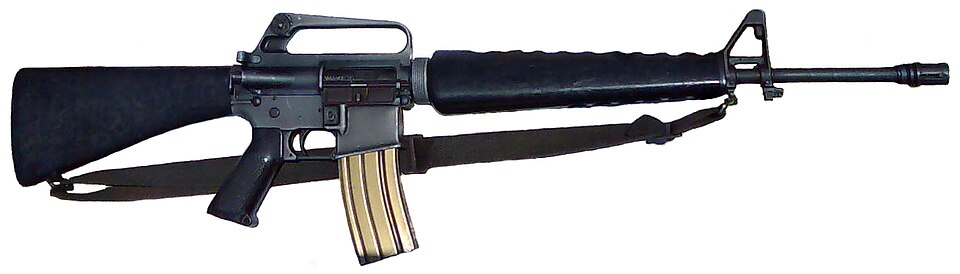
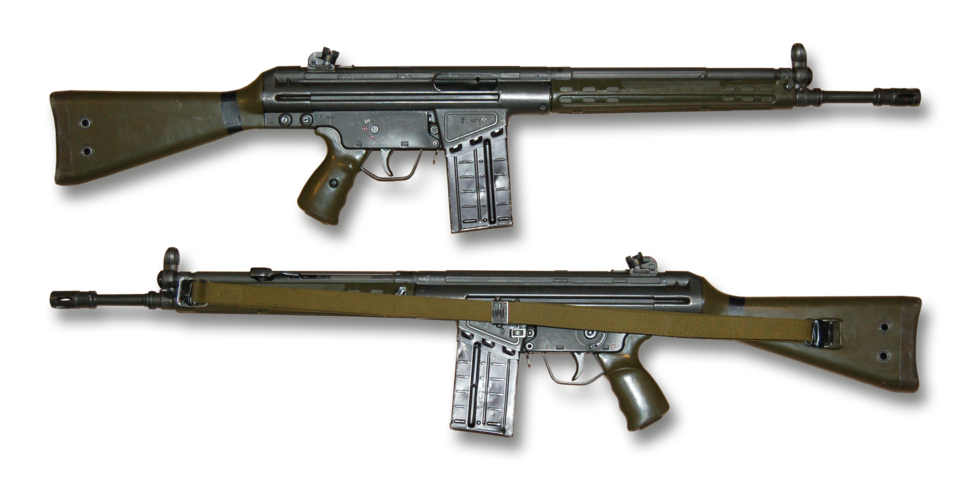
The plain, unadorned muzzle is increasingly rare. Most military weapons since 1940 have some kind of device at the barrel end. These are functional, but they are also visual signatures.
The classic AK-47 slant brake is technically a combined flash hider and compensator, but it looks like a simple slanted cut. That slanted profile is an immediate AK family identifier. Later AK variants switched to birdcage-style flash hiders that look more Western, but the original slant brake is unmistakable.
The M16 family uses a birdcage flash hider with three or four prongs. Early Vietnam-era M16s had a three-prong flash hider notorious for catching on vegetation, so the design switched to a closed-end birdcage. That closed-bottom birdcage separates early M16s from later variants.
Muzzle brakes redirect gas to reduce recoil, usually venting sideways and upward. The downside is increased noise. The German G3 has a distinctive rolling-cone flash hider that looks almost like a small trumpet. The FAL has a more conventional short flash hider with longitudinal slots.
Receiver shape
The receiver is the central body of the firearm. Its shape is dictated by manufacturing method and internal mechanics. A stamped steel receiver looks completely different from a machined forging.
Soviet and Eastern Bloc guns are famous for stamped steel receivers. The AKM introduced a stamped receiver to replace the heavier milled receiver of the original AK-47. A stamped receiver is a sheet of steel bent into a box and riveted together. The result looks rectangular, with visible seams and rivet heads. From a distance, it looks blocky and simple. Not elegant, but cheap.
The original AK-47 had a milled receiver machined from a solid block. That milled receiver is visibly heavier with smoother surfaces and no rivet lines. From a visual identification standpoint, a milled receiver signals either an original Soviet AK-47 or a high-quality modern clone.
German receivers tend to be machined with clean edges. The G3 looks like a rectangular tube. The FAL has a carrying handle integrated into the top cover, creating a distinctive hump. The British SA80 has a receiver almost entirely hidden inside its bullpup shell.
American receivers have their own language. The M16 has a receiver split into upper and lower halves, both aluminum. The seam between them is a horizontal line across the middle. No other major rifle family has that exact split.
The carrying handle distinction
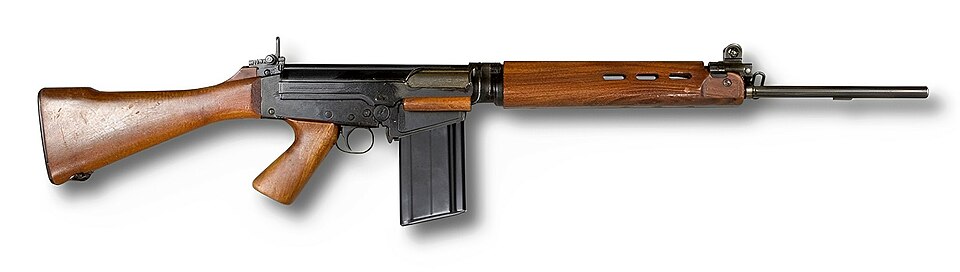
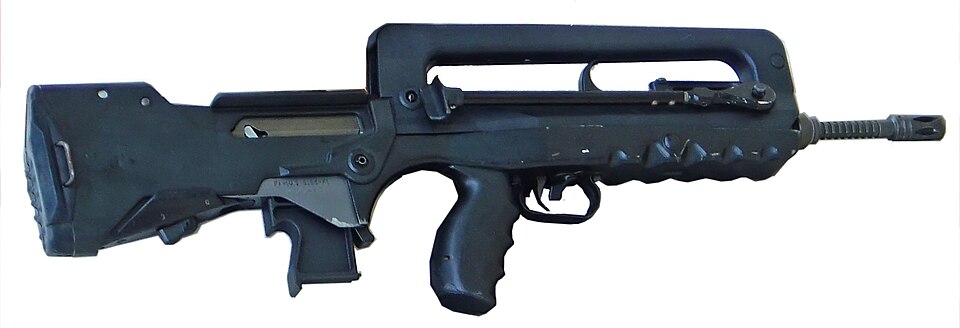
A carrying handle on top of the receiver narrows down possibilities immediately. It was popular from the 1950s through the 1980s because it provided a way to lift a hot rifle and housed the rear sight.
The FN FAL has a carrying handle integrated into the top cover. It is a thin stamped metal loop above the rear sight. From the side, it looks like a small hump.
The M16's carrying handle is part of the upper receiver itself, a solid forged hump containing the rear sight. It sits farther forward than the FAL's. When the M16 transitioned to flat-top uppers in the M16A4 and M4 series, the silhouette changed completely.
The French FAMAS has a carrying handle that runs almost the entire receiver length. That elongated handle separates the FAMAS from every other bullpup. Most modern rifles abandoned carrying handles entirely in favor of flat-top receivers with Picatinny rails. That flat top is itself a signal of a post-1990 design.
The receiver as country signature
Russian receivers tend to be simple, riveted, and built for production speed. German receivers tend to be machined and precise. American receivers tend to be aluminum, modular, and built for customization. British receivers tend to be idiosyncratic, reflecting a tradition that never followed anyone else's rules.
These are tendencies, not absolutes. When you see a receiver that is visibly riveted and boxy, you think Soviet or Chinese. When you see one that is smooth and machined, you think German. When you see a two-part aluminum receiver with a flared magazine well, you think American. When you see a receiver hidden inside a plastic shell with a top-mounted scope, you think Austrian or French.
Learning these patterns does not require memorizing hundreds of models. It requires looking at enough examples that your brain files away the general shapes. Eventually you look at a photograph and feel a gut reaction before naming any features. That intuition is real. It is your visual cortex doing pattern recognition on the receiver shape, barrel length, and muzzle device all at once.
Gun Guesser is an educational geography and history game. We do not endorse, promote, or facilitate the use of firearms. All guides cover external visual characteristics for historical identification purposes only.